What Looks Like a Motivation Problem Is Often a Skill Problem
The Scene Parents Know Well
For many parents, writing struggles do not first appear on a graded paper. They appear at the kitchen table.
Your child sits in front of a writing assignment and does nothing. He stares at the page, writes one sentence, crosses it out, complains that he has no ideas, and melts down before he has even really begun.
What We Usually Assume
Most parents are all too familiar with this scene. To them, it often looks like a motivation problem. They see their child as unwilling to try, careless, distracted, or worse, simply lazy.
But in many cases, motivation is not the real problem at all.
Many apparent motivation problems in writing are actually skill problems. What looks like avoidance is often the behavior of a child who does not know how to do what has been asked of him.
Children cannot say, “I lack sentence-level fluency,” or “I have not internalized paragraph structure.” They simply avoid the task because, on some level, they know they cannot do it well.
Why Writing Feels So Hard
Writing is one of the most demanding academic tasks because it depends on the coordination of so many different skills. A student must generate relevant ideas, turn them into clear sentences, recall spellings, punctuate according to standard conventions, and physically get the words onto the page. At the same time, he must hold multiple thoughts in mind, maintain a sense of structure, and keep track of where the piece is going. Finally, once a draft exists, he is expected to evaluate it against an internal standard of good writing and revise it toward something clearer, stronger, and more coherent.
A child may be bright, verbal, and even imaginative, yet still struggle intensely with writing if those component skills are weak.
While it is certainly possible for a child to be unmotivated, rushed, or simply not to like writing, the reality is that often the child is not resisting effort itself. He is resisting confusion, failure, and the feeling of not knowing how to proceed.
The Skill Gaps We Often Miss
Because writing is a multi-layered task, it is important to ask which underlying skills may be missing when a student struggles. Some children do not know how to generate or narrow an idea. Others do not know how to turn an idea into a clear sentence. Some have weak spelling or transcription skills, so writing feels laborious before it even becomes intellectual. Some have never been taught how to build a paragraph, develop a point, or organize supporting details. And some have not read enough strong prose to internalize the rhythms of written language.
When those gaps exist, writing does not feel merely difficult. It feels overwhelming.
Why Competence Changes Motivation
Motivation often grows when competence grows. As Andrew Pudewa, the founder of the Institute for Excellence in Writing, has said, “Children like to do what they can do.” This principle applies far beyond writing. In general, children are far more willing to engage in difficult work when they have some sense that they can do it successfully. Competence changes not only performance, but also a child’s emotional posture toward the task itself. A child who feels capable is more likely to begin, persist, recover from mistakes, and tolerate correction. A child who feels lost is more likely to hesitate, avoid, complain, or shut down.
This is one reason adults so often misread children’s resistance. What looks like a poor attitude is often discouragement. Children do not always have the language to say, “This feels beyond me,” or “I do not know how to succeed at this.” Their behavior says it for them. By contrast, when effort begins to produce visible progress, motivation often follows. Children become more willing when they become more capable. They begin to take ownership of a task when they no longer feel helpless within it.
Like all of us, children tend to like best what they are good at doing.
What Better Writing Instruction Looks Like
High-quality writing instruction is explicit. It does not assume that children will simply absorb the craft of writing through exposure, repeated assignments, or vague encouragement to “add more detail” or “be creative.” Instead, it teaches the component parts of writing directly. Students are shown what good writing looks like, why it is effective, and how to begin producing it themselves. This kind of instruction reduces confusion. It gives children a clearer sense of what they are being asked to do and a more realistic path for getting there.
One important feature of strong instruction is the use of models. Students benefit from seeing examples of good sentences, strong paragraphs, and well-structured compositions before they are expected to produce their own. A model gives the child a destination. It provides a concrete standard rather than an abstract command to “write better.” Many weak writers struggle not only because writing is hard, but because they have no clear picture of what a finished piece should sound like. When students regularly read and study strong models, they internalize patterns of clarity, coherence, and style that would otherwise remain out of reach.
Good writing instruction is also incremental. Rather than asking children to manage everything at once, it teaches one skill at a time and then helps students practice that skill until it becomes more secure. This may mean working first on sentence patterns, sentence combining, or specific ways of expanding an idea before expecting a full paragraph or essay. It may mean practicing how to write a strong topic sentence before moving on to paragraph development, or learning how to choose precise verbs before worrying too much about stylistic flair. Children who struggle with writing are often overwhelmed by the number of demands involved. Breaking the task into smaller parts makes the work more manageable and allows real progress to take place.
Imitation also plays an important role. Many adults hear the word imitation and assume it is the enemy of originality, but in education it is often one of the surest paths toward it. Children learn in many domains by imitating strong examples before they become independent. Writing is no exception. When students imitate well-constructed sentences, borrow structural patterns, or model their paragraphs on good examples, they are not being robbed of their own ideas. They are gaining tools. Over time, these tools become part of their own expressive capacity. A child who has never learned strong patterns is often much less free on the page than a child who has. As William Zinsser observed, writing is learned by imitation.
“Writing is learned by imitation. If anyone asked me how I learned to write, I'd say I learned by reading the men and women who were doing the kind of writing I wanted to do and trying to figure out how they did it.” -William Zinsser
Another essential part of effective instruction is structure before drafting. Many students are asked to write too soon, before their thoughts have been organized. Strong teachers help students prepare in advance by creating structured outlines, selecting key ideas, and arranging those ideas in a logical order before beginning to draft. Oral rehearsal can also be enormously helpful. When a child says a sentence out loud before writing it, or talks through a paragraph before putting it on paper, he can begin to hear whether his thinking makes sense. Oral language often serves as a bridge to written language. For some students, especially those who are hesitant or overwhelmed, this intermediate step reduces the burden significantly.
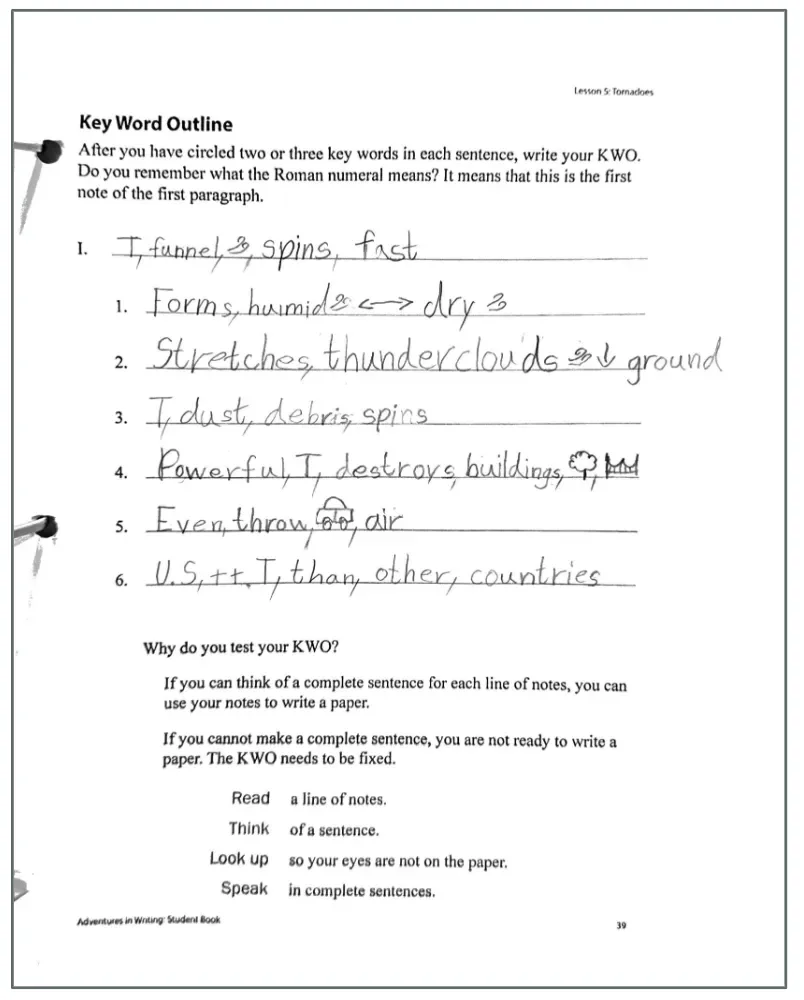
A keyword outline gives the student a clear way to begin. Support like this often makes independence possible.
Direct teacher feedback is equally important. Children generally do not become strong writers by being left alone with assignments and then evaluated only at the end. They improve when a knowledgeable teacher helps them see what is working, what is unclear, and what specific changes would strengthen the piece. Effective feedback is not merely corrective; it is instructive. It helps students understand why one sentence is stronger than another, why a paragraph wanders, why a transition is weak, or why a detail needs to be developed further. In this sense, revision is not simply error correction. It is guided refinement of thought and expression.
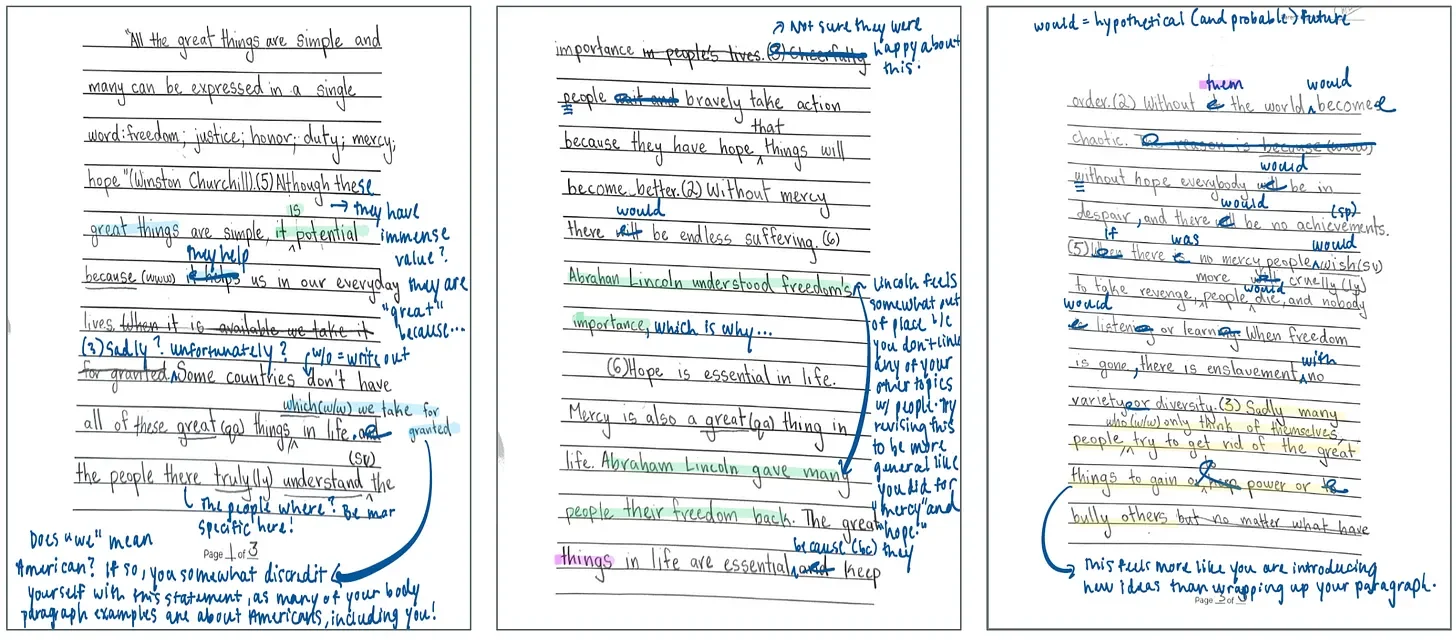
A struggling writer needs specific feedback that clarifies what is weak, what is working, and how to improve the next draft.
The Question We Should Ask First
Of course motivation matters. Habits matter. Attention matters. Effort matters. But before we frame a child’s difficulty as a character issue, we should ask a more basic question: has he actually been taught the skills this task requires?
That question does not remove responsibility from the child. It simply places responsibility where it belongs for the adult as well. If a student is struggling, our first task is not merely to demand more effort, but to consider whether he has been given the instruction, structure, and guided practice necessary to succeed.
A child who resists writing is not always telling us, “I do not want to.” Often he is telling us, in the only way he can, “I do not know how.” When we learn to hear that message more accurately, we respond differently. We teach more clearly. We judge less quickly. And we give children something far more helpful than pressure: we give them a real path forward.